Under the Hood: How V8 & Modern Engines Manage Memory
In low-level languages like C or C++, memory management is manual. If you allocate memory for a variable, you must personally free it up when you're done. Forget to do it? You get a memory leak. Free it twice? You crash the program.
In modern high-level languages like JavaScript, Python, or Java, we rarely think about memory. We create objects, arrays, and functions freely, and when we stop using them, they disappear.
That "magic" is performed by a background engine component called the Garbage Collector (GC).
To write high-performance applications and debug sneaky memory leaks, we need to peek under the hood at how engines like Google's V8 (which powers Chrome and Node.js) actually allocate, track, and clean up memory.
1. Stack vs. Heap: Where Does Data Live?
When V8 executes your JavaScript code, it splits RAM into two primary regions inside the Resident Set:
+-------------------------------------------------------------------+
|                           RESIDENT SET                            |
|                                                                   |
|  +------------------+  +---------------------------------------+  |
|  |   STACK SPACE    |  |              HEAP SPACE               |  |
|  |                  |  |  +---------------------------------+  |  |
|  | - Primitives     |  |  |   New Space (Young Generation)   |  |  |
|  | - Pointers       |  |  +---------------------------------+  |  |
|  | - Execution Context| |   Old Space (Old Generation)    |  |  |
|  +------------------+  +---------------------------------------+  |
+-------------------------------------------------------------------+
1.Stack Memory: Stores static data, function execution contexts, primitive values (number, boolean, string), and pointers/references that look into the Heap. Fast, structured, and managed automatically by CPU stack frames.
2.Heap Memory: A massive, unstructured pool of memory where dynamic data objects, arrays, functions, and closures live. This is where Garbage Collection happens.
2. The Generational Hypothesis & V8 Memory Spaces
V8 structures its Heap based on a proven empirical observation known as the Generational Hypothesis:
"Most objects die young."
In JavaScript, most variables are short-lived—created inside a function or loop iteration and discarded within milliseconds. Long-lived objects (like user authentication state or application configurations) are rare exceptions.
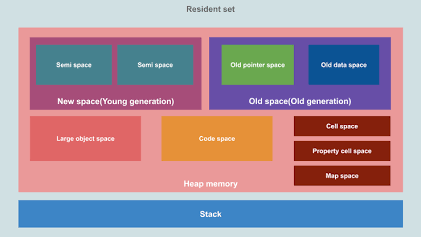
To optimize performance, V8 divides the Heap into two generations:
A. New Space (Young Generation)
- Size: Small (typically 1MB to 64MB).
- Purpose: Where all newly allocated objects (const user = ) arrive first.
- Collector: Cleaned very frequently by the Minor GC (Scavenger).
B. Old Space (Old Generation)
- Size: Much larger (hundreds of megabytes or gigabytes).
- Purpose: Holds objects that survived two Garbage Collection cycles in the New Space.
- Collector: Cleaned by the Major GC (Mark-Sweep-Compact).
3. How Garbage Collection Algorithms Work
Minor GC: The Scavenger (Cheney’s Copying Algorithm) Because objects in the New Space die quickly, Minor GC uses a high-speed copying algorithm:
The New Space is divided into two halves: From-Space and To-Space.
New allocations land in From-Space.
When From-Space fills up, Minor GC triggers. It scans for reachable (alive) objects and copies them into To-Space, compacting them tightly together.
Unreachable (dead) objects left in From-Space are instantly overwritten.
The roles flip: To-Space becomes the new From-Space!
Promotion: If an object survives two swap cycles, V8 promotes it to the Old Space.
Major GC: Mark-Sweep-Compact Because the Old Space is massive, copying objects back and forth would destroy application performance. Instead, Major GC uses a three-stage algorithm:
[ Root (window) ]
       │
       ├──> [ Active State ] 🟢 (Marked - Keep)
       │         │
       │         └──> [ User Profile ] 🟢 (Marked - Keep)
       │
       └──> [ Disconnected Object ] 🔴 (Unmarked - Sweep!)
- Marking: V8 starts from global Roots (window, global variables, active stack frames) and traverses the pointer tree. Every object reached is tagged as "Alive".
- Sweeping: The engine scans memory addresses. Any object not tagged as reachable is swept into a Free List so new allocations can reuse that memory space.
- Compacting: Over time, sweeping leaves fragmented holes in RAM. Compacting shifts surviving objects together to reclaim continuous blocks of memory.
4. How V8 Eliminates "Stop-The-World" Latency
Early JavaScript engines paused all code execution while running Major GC (known as a Stop-The-World pause). If GC took 200 milliseconds, your UI froze and dropped frames.
Modern V8 uses three concurrent techniques (via the Orinoco GC engine) to keep your apps smooth at 60+ FPS:
-
Parallel Marking: Spreads GC tasks across multiple background worker threads simultaneously.
-
Incremental Marking: Breaks major GC work into tiny micro-steps executed between turns of the Event Loop.
-
Concurrent Marking: Background threads mark the object graph in RAM while your main JavaScript code is running!
5. Three Sneaky Ways Developers Cause Memory Leaks
Even with modern Garbage Collectors running, objects that are no longer needed can remain attached to global roots, preventing the engine from sweeping them away.
- Detached DOM Nodes Occurs when an element is removed from the UI, but a JavaScript variable still holds a reference to it in RAM.
// ❌ Memory Leak
let submitButton = document.getElementById("submit-btn");
document.body.removeChild(submitButton);
// The button is gone from the screen, but submitButton keeps it alive in RAM!

// ✅ Fix
submitButton = null; // Detaches the pointer so GC can sweep it
- Forgotten Timers & Callbacks setInterval callbacks retain closures that keep surrounding variables alive indefinitely until cleared.
// ❌ Memory Leak
const timerId = setInterval(() => {
  const hugeData = fetchUserData(); // Keeps hugeData in scope permanently
}, 1000);

// ✅ Fix
clearInterval(timerId); // Unregisters the timer from the root scope
- Accidental Global Variables Variables declared without let, const, or var bind directly to the window global root in non-strict mode and survive until the tab is closed.
function loadData() {
  cache = new Array(1000000); // ❌ Attached to window.cache!
}
Summary Cheat Sheet 💡
| Concept | What it handles | Key Trait |
|---|---|---|
| Stack Memory | Primitives & function calls | Ultra-fast, managed automatically |
| Heap Memory | Objects, Arrays, Closures | Dynamic pool managed by Garbage Collection |
| New Space (Young) | Fresh, short-lived objects | Cleaned fast by Minor GC (Scavenger) |
| Old Space (Old) | Long-lived, promoted objects | Cleaned by Major GC (Mark-Sweep-Compact) |
| Mark-and-Sweep | Root-tracing garbage detector | Frees unreachable objects starting from window |